
In 1889, Andrew Carnegie published his essay The Gospel of Wealth, calling upon his fellow elites to address the emerging disparity of wealth in America (one wonders what he would say about today’s divide). In it, Carnegie argues that the wealthy have a moral imperative to live modestly and administer their wealth for the public good while they are alive, rather than hoard it for generations through patrimony or bequeath it to the state upon death. One can debate the finer points of Carnegie’s proposed method of administration; for instance, he posits it is better to use individual wealth to create “ladders upon which the aspiring can rise,” such as libraries, museums, and parks, rather than donate money directly to the poor, whom he assumes would not know how to steward it properly. What is indisputable, however, is the profound effect Carnegie’s philosophy on philanthropy has had on American culture.
“The man who dies thus rich dies disgraced.”
Andrew Carnegie
We see his influence reflected in American cultural policy during the 20th century (something we have been learning in our Cultural Policy class). Following WWII, the United States recognized the need for a robust cultural sector rivaling that of the Soviet Union in order to prove that American way of life was superior. But the federal government faced a quandary: how to quickly create a potent cultural sphere while still limiting the powers and influence of the state?
What transpired over the next several decades is a hodgepodge of policies and initiatives that resulted in more of a “marble cake” framework of funding, legislating, and producing culture than a clearly stratified “layer cake” type of framework. The United States’ approach toward cultural policy is perhaps best encapsulated in its address to members of the 1967 Roundtable of Monaco, where UNESCO prompted participants to create profiles of national cultural policy, thereby establishing the most basic cultural policy norm: that nations have cultural policies. Despite having significantly expanded its role in culture at that point – as evidenced by the formation of federal agencies like the Smithsonian, the NEA/NEH, and the National Park Service – the United States opened its enigmatic address with this now-famous line: “The United States has no official cultural position.”
Of course, the United States has not been as laissez-faire in its cultural policy as it would like to portray. Still, despite many complexities, ironies, and anomalies, American cultural policy has largely been pluralistic and deferential to states, municipalities, and individuals. Consider, for instance, charitable giving to arts, culture, and humanities regularly dwarfs that of public funding. (In 2019, charitable giving outweighed public funding $21.64 billion to $1.47 billion, which was the combined amount of federal/state/local dollars). And, to this day, there is no official Ministry of Culture. With occasional exceptions, the United States has demonstrated a preference to invigorate the cultural sector indirectly through tax incentives, counting on its wealthy citizens to fill the gaps by living out The Gospel of Wealth.
I see this dynamic at play in the Dallas/Fort Worth cultural landscape. The area is brimming with arts institutions named after wealthy families. In recent weeks, our fundraising class visited two of them: The Nasher Sculpture Center in Dallas and the Kimbell Art Museum in Fort Worth. Both organizations were founded with enormous endowments from wealthy benefactors that continue to sustain as much as half their annual revenues. This allows them to offer free, or very affordable, general admission while maintaining world-class facilities, collections, and programs with virtually no public funding.

James Ryan Jillson, Director of Development for the Nasher Sculpture Center, giving a tour of the museum for our fundraising class. 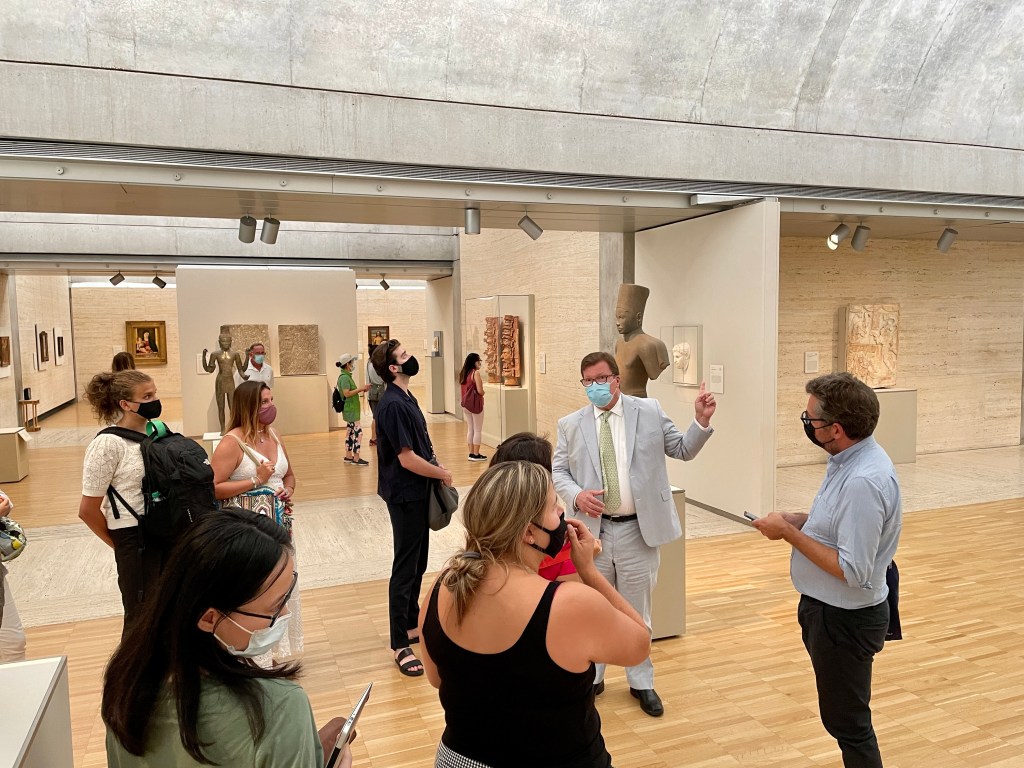
Deputy Director George Shackelford giving our fundraising class a tour of the Kimbell Art Museum
There are myriad benefits to this type of philanthropy, but I can identify at least one potential risk involved in accepting a named gift: it is a fraught ordeal if you ever need to sever ties with that donor. Case in point: The Sackler family and the many institutions now regretting having accepted named gifts from them. For an institution to annul any association with a name that has become culturally toxic, it must overcome all kinds of financial, legal, and moral hurdles, because once the donation has been received, the named rights for the donor are often bestowed in perpetuity.
In an era when reputations are hyper-scrutinized and mere association with a person or corporation deemed “toxic” can lead to mass protests and boycotts (a.k.a. “cancel culture”), I would expect arts and cultural institutions to be extra cautious before accepting a named gift. But, in speaking with a chief philanthropy officer in Dallas recently, I’m not sure this is the case.
Last week, my fundraising class met with the VP, Development for the AT&T Performing Arts Center. AT&T secured the naming rights to the Center when it opened in 2009. The Center also received several naming rights to its various performance spaces from families and individuals, and the VP told us that named gifts remain a significant part of the Center’s fundraising strategy. After explaining my theory on the growing risk carried by named gifts, I asked if the Center had considered adding any stipulations to the named gift contracts that could make a severance from the donor easier, if needed, in the future. Based on her reaction, it seemed this was the first time the VP had ever encountered this proposition. She told me the naming rights to the Center are for 30 years, so the Center could not rename itself before 2039; the other naming rights are currently held in perpetuity; and that, until I had brought it up, the Center had not considered adding any stipulations to future named gift contracts.
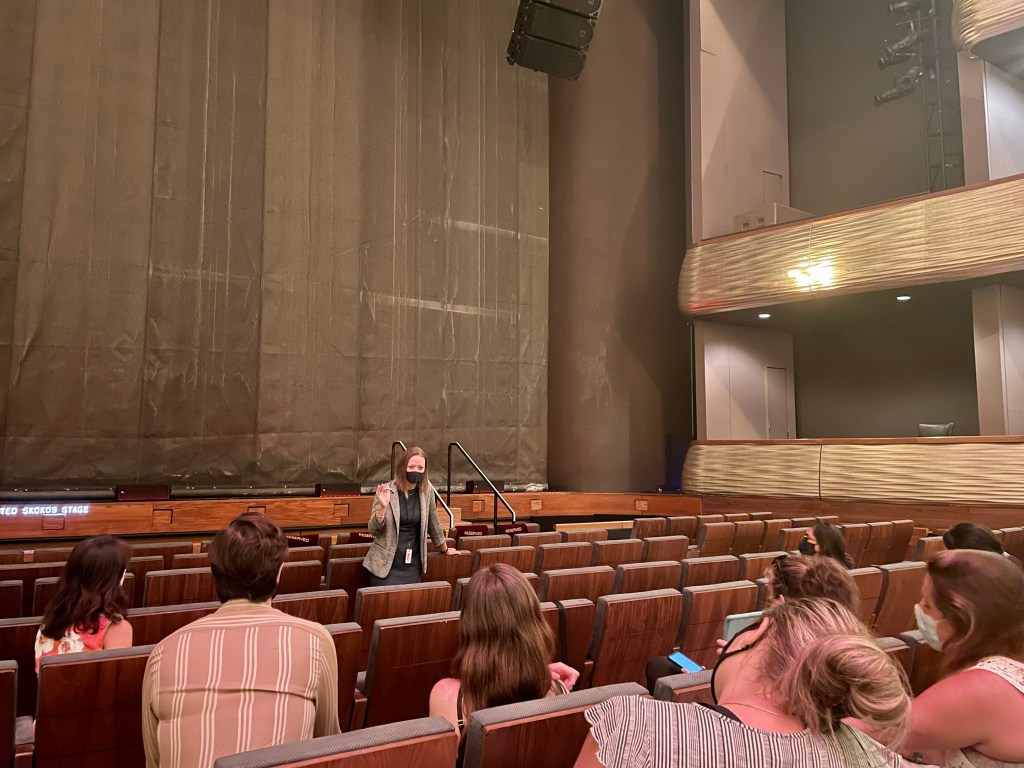
Perhaps the risk of a named rights catastrophe is not great enough to warrant a change in how named gift contracts are structured. I certainly don’t know enough about the process to make a strong case one way or the other. But it’s been interesting for me to learn about these topics and to consider how they interrelate in my various classes and play out today in the community where I’m living. And, in reflecting on the enduring influence of Carnegie’s The Gospel of Wealth over the last 130 years, it seems to me that naming rights are not the only things that live on in perpetuity.
What are your thoughts? What are the risks/rewards of the United States’ “no policy is our cultural policy” stance? Where do you see The Gospel of Wealth at work today? Where do you see its failings? Should nonprofit organizations be more cautious about naming rights in today’s social climate? Comment below!
 My MMIAM Journey