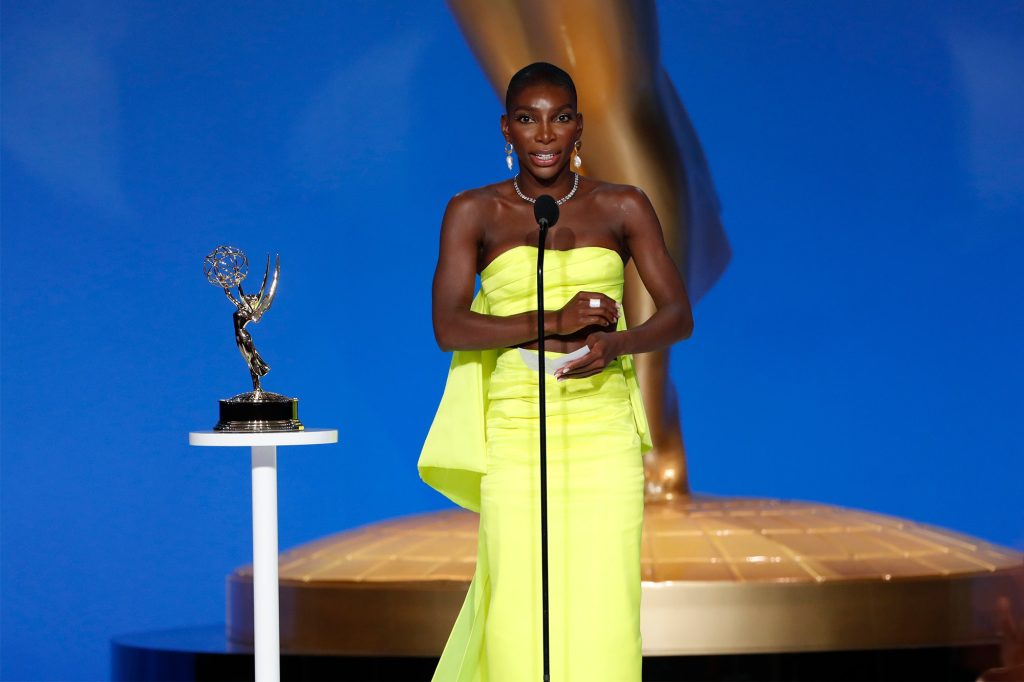
At the 2021 Emmy Awards last month, Michaela Coel won the Outstanding Writing For a Limited or Anthology Series or Movie award for her miniseries I May Destroy You. The first Black woman to ever win the award, and one of only a few people of color to win any award that night, it was an all-around feel-good moment for everyone, punctuated by her inspiring acceptance speech which immediately went viral. What most don’t know is that Coel achieved an arguably even more important victory for her writing before her show was even filmed.
As revealed in a profile published by Vulture in 2020, Coel turned down a $1 million offer from Netflix in spring 2017 because they wouldn’t allow her to retain any percentage of the copyright. She tried negotiating to retain “at least 5 percent of the copyright” and even bargained down to just .5 percent of the copyright, but Netflix wouldn’t budge on any deal that didn’t grant them full exclusive ownership of the copyright. Coel would eventually reach a deal with BBC (with HBO as a co-producer) that gave her everything she wanted, from “a seat at the table on the production side” to “full creative control and the rights to the work.”
When you consider the deeply personal nature of the show (it is based on a sexual assault Coel experienced years earlier); the fact Coel wrote 191 drafts of the screenplay; and she would go on to produce, co-direct, and play the main character in the show; you can understand why retaining creative control would mean everything to her. Theoretically, if Netflix had complete ownership of the copyright, they could create spin-off series, license the characters to make toys, any number of things that would substantially alter the original meaning, intention, and purpose of the show. To be fair, if you look at it from the side of Netflix, whose current business model is dependent on them out-producing their competitors for original content to which they have complete ownership, you can understand why they would remain adamant on full copyright ownership. If they gave Coel ownership rights, she could theoretically find other licensing partners for the program in the U.S. and abroad, which is a risk they couldn’t accept.
As a mega-fan of I May Destroy You, I had read the article about Coel a year ago when the show aired, and when Coel won her Emmy, I was reminded of her copyright deal because we are studying copyright and licensing in our International Arts Law course. I wanted to get clarity on the practical implications of a joint copyright ownership and what difference the percentage of that ownership makes. For instance, what difference would 5% ownership versus .5% ownership make for Coel and Netflix? I reached out to my professor, and she happily guided our class through the scenarios. As she explained it, joint ownership can be created a few different ways. Below are some examples:
- Two writers work on the same screenplay and collaborate, but no contract is signed about percentage of ownership. Each co-wrote and co-edited the screenplay. Result: each writer would have equal rights to exploit, license, and sell the screenplay, but any profits made would be split equally between the two writers, even though the other writer may have done nothing to market the screenplay.
- Two writers work on the same screenplay and collaborate, but a contract is signed about percentage of ownership, and the split is 95% and 5%. Each co-wrote and co-edited the screenplay. Result: Unless the contract only gave one writer the ability to exploit, license, and sell the screenplay, both writers could do so and would split the profits 95/5.
- Coel/Netflix situation: Netflix would not give her 5% or even 0.5% of any ownership. Netflix would make all profits off the series now and in the future and only pay Coel the royalty amount agreed to in their contract. This royalty amount could be a one-time flat fee or a percentage of the profits Netflix makes based on the deal terms to which they each agreed. She would not be an owner of the screenplay anymore and would have no rights to license it, sell it, or adapt it in the future. If Netflix had given her 5% of ownership, they would always owe her 5% of the profits in the future and could not enter into any agreement to license or sell the show to a third party without her signature and consent. Upon selling the show, Coel would receive 5% of the profits.
What do you think? Does this give you a greater respect for artists like Michaela Coel who fight for their copyright ownership? Could a “producer for hire” deal where Netflix retains ownership but pays an above-market fee or royalty still make sense for some artists? What new thoughts or questions do you have about creative control in the arts world? Comment below!
 My MMIAM Journey