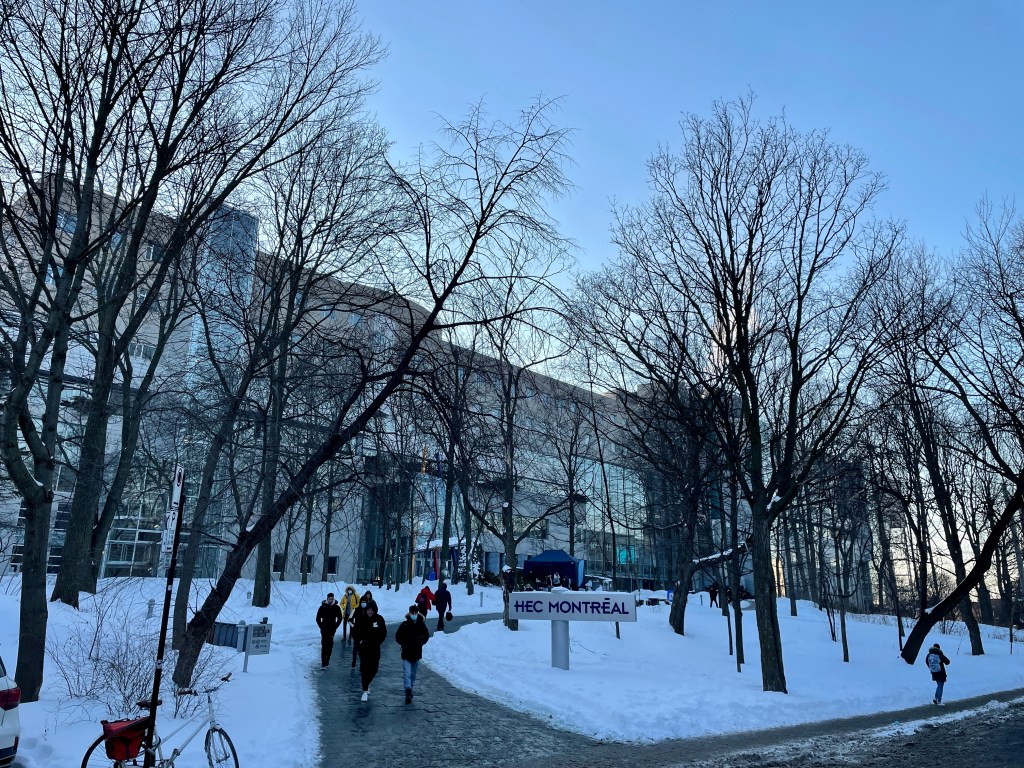
To summarize my experience from each leg of my graduate school travels, I decided to interview an expert: myself! Here is my overview of Montréal:
What were your first impressions of Montréal?
It was cold! (This became a pattern throughout the year where we’d arrive in places during the most extreme weather seasons). But seriously, Montréal is frigid in the winter and it snowed a lot more than I expected. The other big thing you notice when you arrive is the Francophone nature of the city. It is bilingual enough that you can usually get around easily enough speaking only English, but the primary language is French. So you have to get used to reading everything in French, and when you meet people they will most likely expect you to speak French first. The other noticeable thing about Montréal is its European feel. The architecture, zoning, etc. makes it feel like you are in Europe and not North America.
How long were you there?
I arrived on New Year’s Eve. In fact, I had an exceptionally long wait (three hours) in the Canadian immigration center upon arriving at the airport, so when the clock struck midnight, those of us in the waiting room let out a timid “Happy New Year!” for fear of the immigration officers being unpleased with any outbursts. (That’s one NYE I’ll never forget). I was in Montréal until mid-April when we flew to Bogotá. After the Bogotá trip, we returned to Montréal for a few nights, repacked our bags, and flew to Mumbai at the start of May.
Where did you stay?
I had a studio apartment to myself in the Le Plateau neighborhood. For those of you reading this who are familiar with Montréal, my place was on Saint Denis, between the Mont-Royal and Laurier train stations. The unit was very basic, nothing fancy at all, but the location was fantastic. I could get to HEC’s campus or downtown by bus or train in 20-30 minutes consistently. My neighborhood has a young, artsy, somewhat gentrified feel to what was a previously less-inviting area in the city. Most of the buildings are covered in graffiti and you see lots of twenty- and thirty-somethings around.
I was in Montréal most of the time, but I did make a few trips to Quebec City (I dated a girl who was living there for a short time). Some of my peers and I also rented a chalet in Charlevoix for a weekend and went alpine skiing and hiking.
What were your classes like?
HEC Montréal taught this part of the program. The pedagogy was almost exactly opposite that of SMU. The semester was split into two halves; each half had five one-and-half-credit courses. This semester had a strong marketing focus to it. For perspective, four of our classes were titled: Arts Marketing, International Arts Marketing, Global Communications, and Managing Global Cultural Products. We also had courses in leadership, innovation, research, finance, and database management. The pace and course load was probably twice that of SMU. (This is why I had to give up on my blogging). It also had the graduate-level feel I was expecting, where students were assigned a reading or writing to do outside of class and then expected to dissect and discuss it more in depth during class. However, it felt like we only ever got a surface-level knowledge of the subject matter because everything was so fast-paced and short-lived (we literally met no more than six times for any given class). Also, because of the weather and COVID situation in Montréal that semester, we spent much less time outside the classroom meeting arts managers and exploring facilities than many of us had hoped.
Any highlights from this part of the program?
The weekend in Charlevoix was a definite highlight. Three of my peers and I joined four other students for the trip. I had never been alpine skiing before, so that was a really thrilling experience. The slopes were beautiful too. I’ll never forget our ski instructor, Claude, a burly, middle-aged French Canadian with a frost-bitten face and strong Quebecois accent who very enthusiastically taught us how to ski and yelled encouragement at us if we did something properly. We also hiked a beautiful national park the following day. Every evening, we took turns cooking “family dinners” for each other and then would drink, play games, and hang out in the jacuzzi late into the night. We rented what ended up being a very suspect car in Montréal through an Uber-like service that offers vehicles belonging to plains-clothes owners because it was cheap. But between the condition of the car and the extreme cold weather, it died by the time we arrived in Charlevoix. While it was stressful in the moment, even that ended up becoming a memorable adventure unto itself.
I also enjoyed my visits to Quebec City and it was fun to spend time with someone new outside our cohort. Quebec City is even more European than Montréal. They have a giant luge for the public to ride, which is really fun. We dined at an incredible, authentic French restaurant one time. And we hiked a couple trails in nearby national parks that had spectacular views of waterfalls and snow-covered mountaintops.
Any lowlights from this part of the program?
We ran into really bad luck at the start of the semester. The Omicron variant was raging and Quebec took a very stringent policy on preventing the spread of infection. So for the first month or so, every restaurant was closed for dining and we couldn’t go out and see any sights indoors. We also got dumped on by a blizzard in January, so between that and the pandemic-induced restrictions on life, several of our classes shifted to online learning and we were cooped up in our apartments for a long time. Then, as the government restrictions started to ease later in the semester and the temperature started warming, half our cohort came down with COVID (including myself), and so that disrupted many of the activities planned for us and eliminated some opportunities we had hoped for.
Do you have a good story to tell that’s not necessarily a highlight or lowlight?
There is not a lot to do in Montréal in the winter, other than ice skate, which I did a couple times. But one event everyone looks forward to is a big festival downtown called La Nuit Blanche. It’s one-night only and features a whole array of art installations, concerts, and activities. In years past, I think there is more to do outside, but because of the pandemic, I think, most things shifted indoors and required masks and limited entries. This meant having to wait in long lines in the freezing cold, which isn’t fun. Long story short, I spent a lot of time wandering and waiting in the cold with my friends but never got to see any actual exhibitions.
What is something you learned in Montréal?
I saw first-hand the role of governmental funding of art and culture in Canada, and the effects that has on the management of institutions. Generally, art and culture is very well-funded by tax dollars in Canada. As a result, the concept of philanthropic donations to arts and cultural organizations is virtually non-existent. We met with the manager of a small nonprofit that trains unemployed or underemployed people from economically disadvantaged communities to become light, sound, and stage managers for theatrical productions. A company like Cirque du Soleil, for example, will contract with this organization for these services. The organization gets an agency-like cut of every contracted graduate from their training program. This model very nearly earns enough revenue to balance its expenses, but it must rely upon a small annual grant from the government. If that grant were to ever run out (and every year, it seems like a possibility), the organization would not sustain itself and inevitably collapse. When I proposed the manager could hire a fundraiser to supplement the earned revenue of the organization and provide more stability (surely there are many people who would love to donate to an organization with a mission like theirs), I was surprised at how dismissive the manager was to the idea. It seems almost like a taboo subject, like there is a stigma if the organization asked for “handouts.” Even though the organization has nonprofit status and is governed by a board of directors, they take such pride in being self-sustaining they would rather fail than “resort to fundraising.”
Did your impression of Montréal change by the end of the experience?
By the end of the semester, the weather had thawed and life started to return. I had met more people in Montréal and experienced more of the city’s offerings. The public transportation system is excellent and the city is very accessible. People are friendly and interesting; many are immigrants of other countries. Restaurants are a big part of the city’s culture; there are great restaurants everywhere. Things are generally cheap, especially when you factor in the US to Canadian dollar exchange rate. There is also a lot of innovation happening from the burgeoning tech sector there. This attracts a lot of young, forward-thinking people, and you see a lot of advanced technology like AI and AR/VR being infused into the arts in Montréal. I came like the city very much and would like to return when the weather is more pleasant.
How would you summarize your experience from this part of the program?
The Montréal semester is when the academic pace and workload really ramped up. I felt the most pressure to keep up with my studies during this semester. As the first foreign travel part of the program (for an American) the Montréal semester also offered a lot more novelty and injected a new, interesting dynamic to the living and learning experience. We faced our fair share of adversity from the weather, pandemic, and some personal issues among our cohort during this semester. But I will always fondly remember Montréal and Quebec City and will also remember many of the valuable lessons from our studies at HEC.

 My MMIAM Journey